CoralBay UK | Reefkeeping and buying advice
Are expensive SPS corals really worth it?
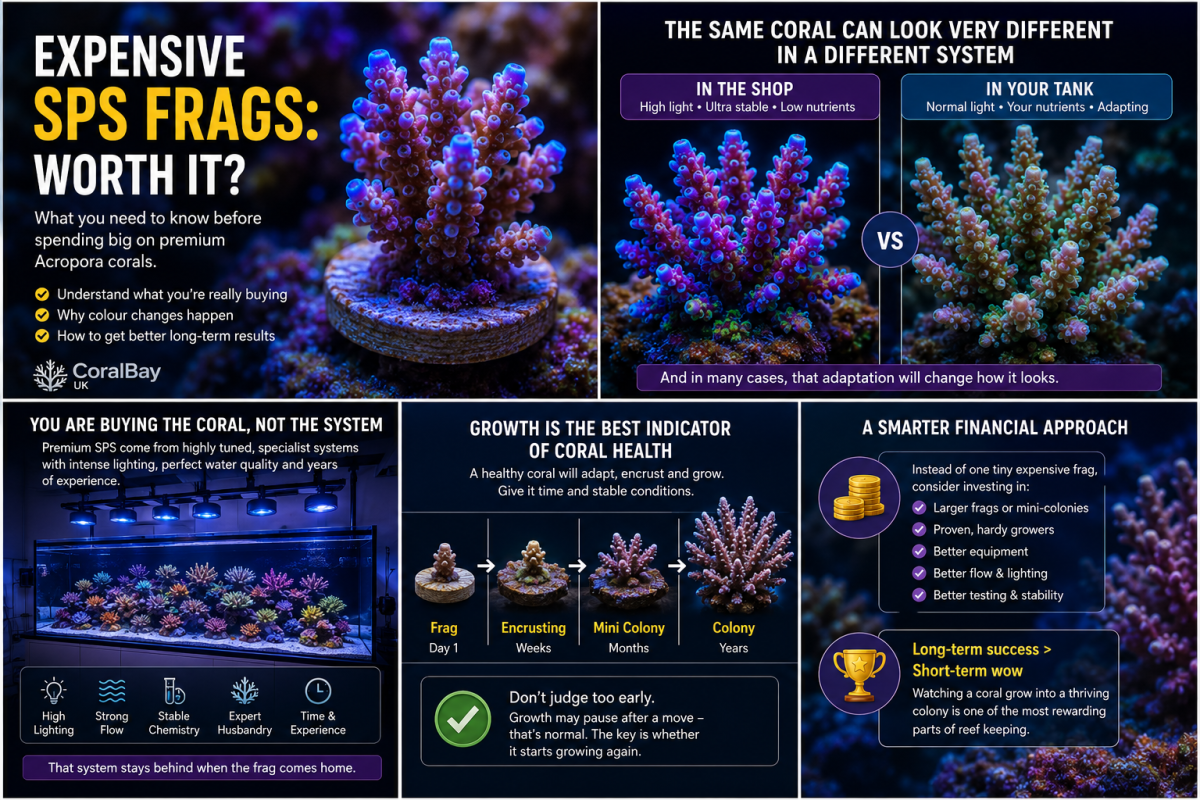
Electric colours, fluorescent tips and tiny frags with surprisingly large price tags. Premium Acropora can be extraordinary, but will the coral look the same in your aquarium, and what are you really paying for?
This is not a criticism of specialist SPS growers. Some maintain exceptional systems and produce beautiful, healthy corals. It is a question for the buyer: is that particular coral worth the premium to you?
First, some credit where it is due
Premium SPS corals can be genuinely spectacular
Anyone who has seen a thriving specialist Acropora collection will understand the attraction. Strong growth, sharp colour transitions and glowing tips can be the result of years of knowledge, investment and careful husbandry. It is entirely reasonable for growers to charge for that work.
But it is also reasonable for buyers to ask what portion of the asking price reflects the coral itself, what reflects the effort required to produce it, and what reflects scarcity, reputation or demand.
Those are different things. And none automatically tells you whether a particular frag will thrive in your tank.
The coral
Its genetics, growth form, pigments, condition, size and history.
The grower
Time, equipment, electricity, losses, selection, care and successful propagation.
The market
Popularity, limited supply, named lineage, presentation and what buyers are willing to pay.
The key difference between aquariums
You are buying the coral, not the conditions it grew in
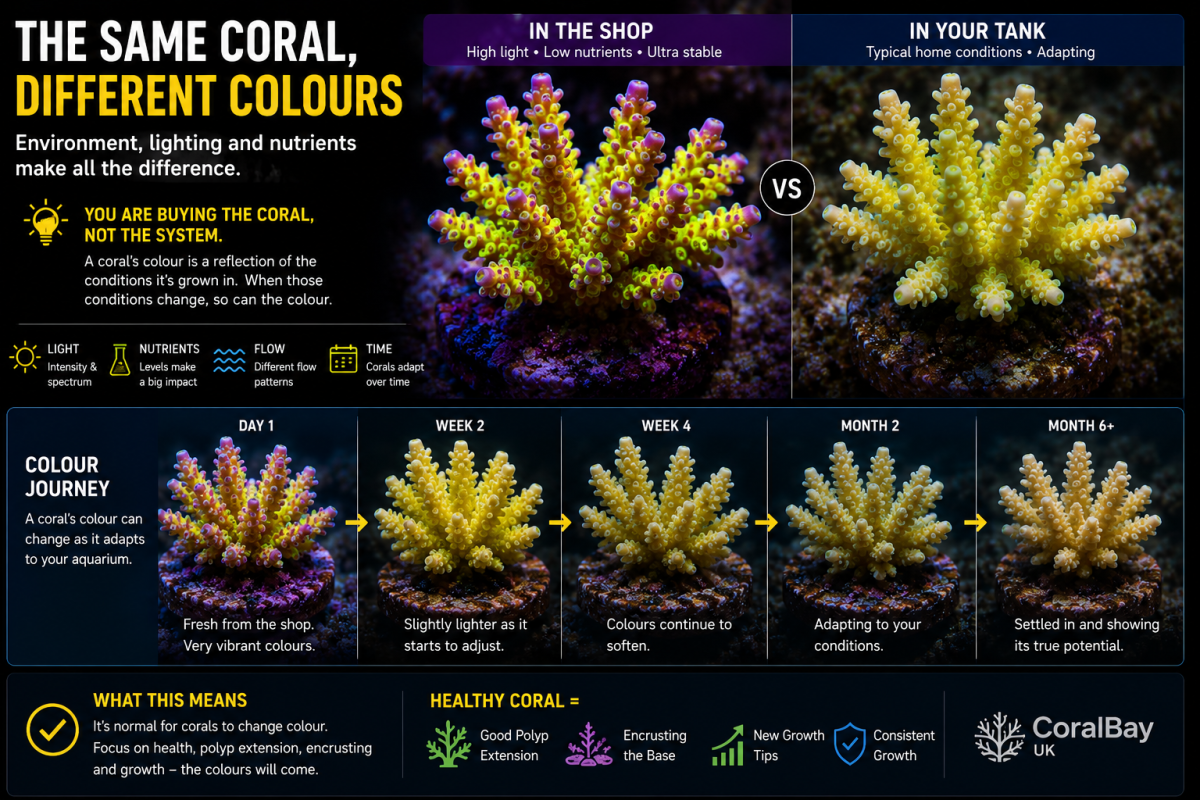
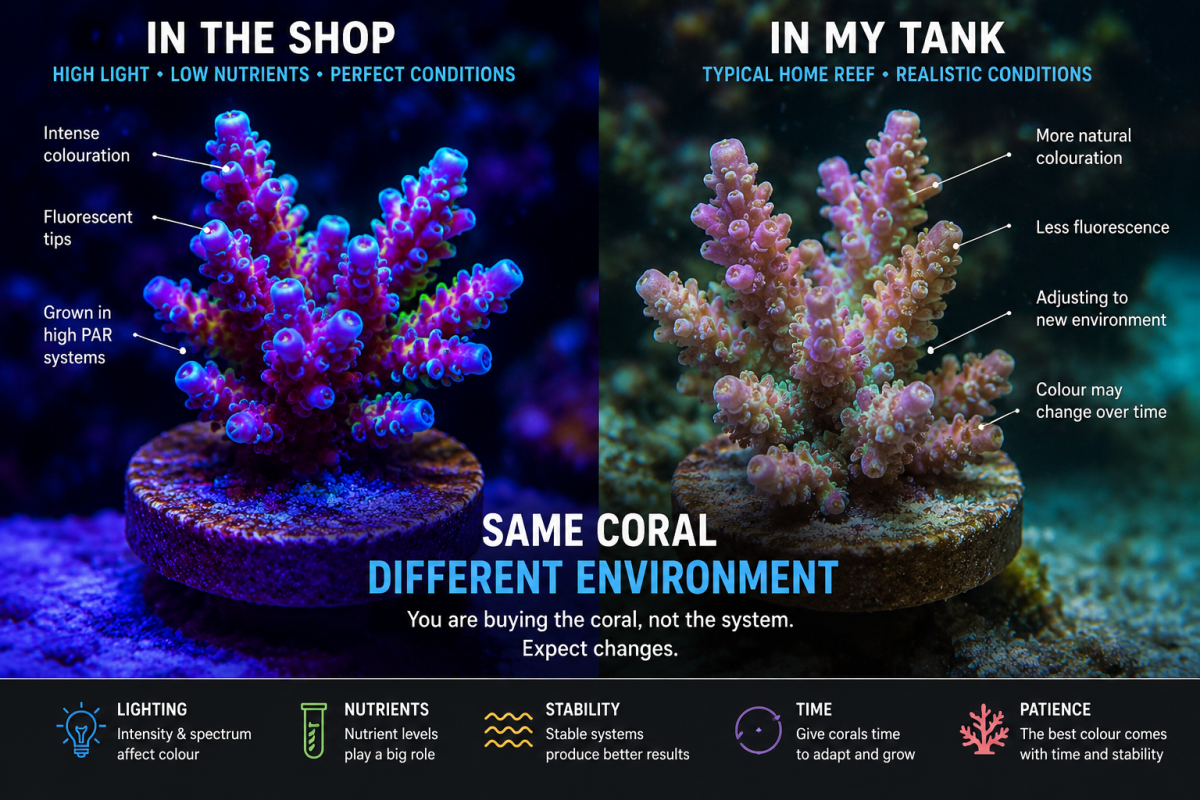
One of the easiest mistakes in SPS keeping is assuming that a coral's appearance will transfer unchanged from one aquarium to another. It might remain very similar, but there is no guarantee.
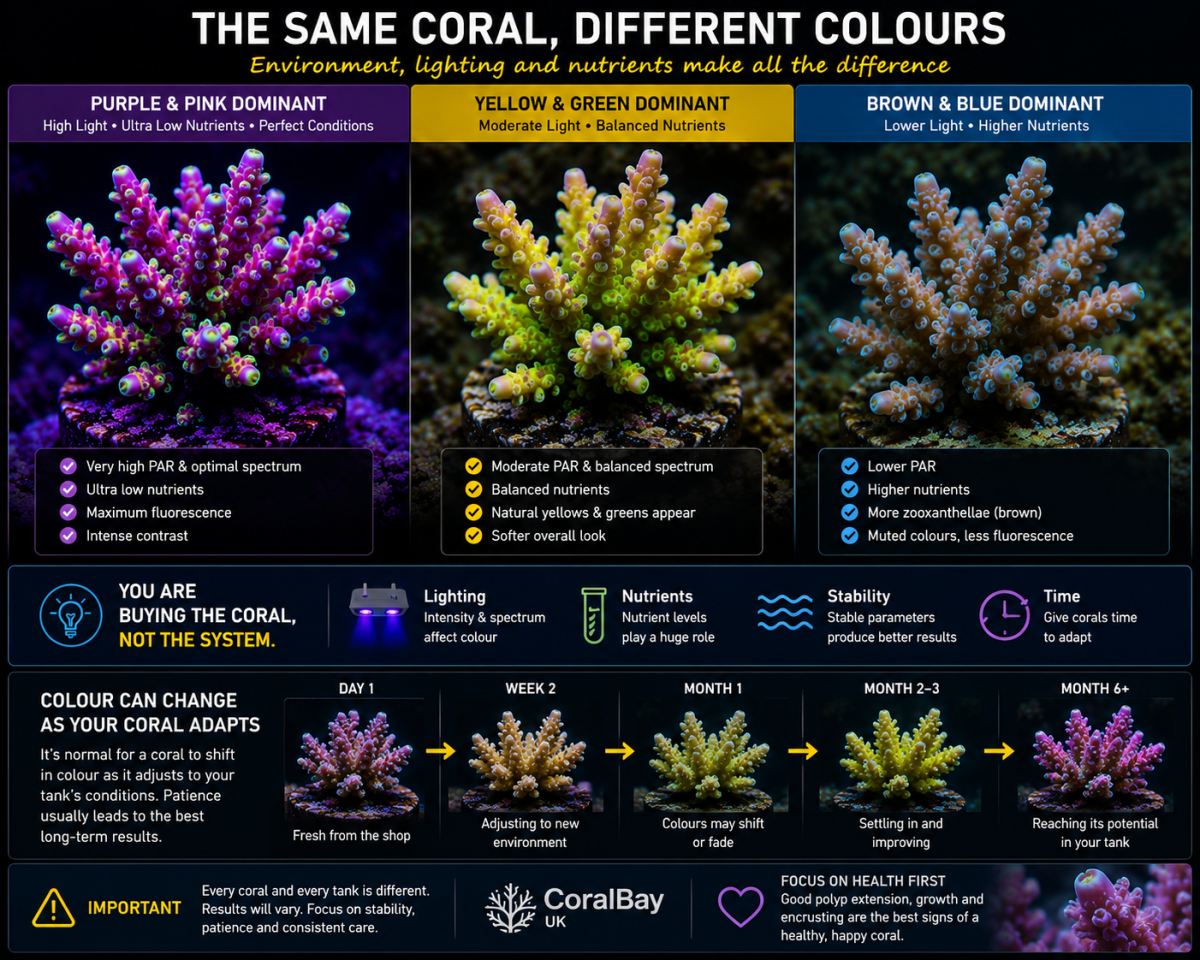
Light intensity and spectrum, flow, nutrients, feeding, trace-element availability, temperature and the stability of the overall system can all influence growth and colour. Two healthy aquariums can produce noticeably different appearances from frags of the same lineage.
This does not mean the seller's colour is artificial or that your aquarium is inadequate. It means living corals respond to their environment.
A useful buying question: "Could you tell me roughly what lighting, flow and nutrient conditions this frag has been growing under?" You don't need to replicate the seller's aquarium exactly, but the answer can help set sensible expectations.
Understanding the colour
Coral colour is more than a single nutrient number
Most reef-building SPS corals live in partnership with photosynthetic microorganisms, often called zooxanthellae. These symbionts contribute brownish and golden tones and provide much of the energy the coral needs. The coral animal also produces its own colour pigments, including proteins that can fluoresce under certain light wavelengths.
How those pigments appear depends on several interacting factors: coral genetics, symbiont abundance, lighting, acclimation and husbandry. A coral can look more colourful under one spectrum, browner under another, or change over time without becoming a fundamentally different coral.
Very pale colour is not automatically better colour. A stressed or bleached coral can lose symbionts and look unusually light, but that is not the same as healthy, stable fluorescence. Pushing nutrients or light to extremes simply to chase a photograph can be counterproductive.
Fluorescence
Some coral proteins absorb shorter wavelengths and emit visible light at different wavelengths. Blue-heavy lighting can make this fluorescence especially striking.
Everyday appearance
A coral can be healthy and attractive under a more balanced viewing spectrum, even if it looks less dramatic than a heavily blue-lit sales image.
What the photograph cannot tell you
The electric coral effect
Under predominantly blue light, fluorescent greens, oranges, reds and other pigments can look extraordinary. Cameras, filters, exposure and white-balance settings also affect what we see on a screen.
That does not make every dramatic photograph misleading. It does make the viewing conditions important. If a frag is expensive, asking for a recent photograph of the actual piece for sale, ideally under both blue and a more balanced spectrum, is entirely reasonable.
Named strains and distinctive colour combinations may carry genuine value, particularly when a lineage has been maintained and propagated consistently. But names alone are not proof of exceptional growth, survival or colour under your own lighting.
Before paying a premium: ask whether the image is of the actual frag (WYSIWYG) or a mature mother colony used to illustrate the potential appearance. Both can be useful, provided the distinction is clear.
Frag size and long-term success
Tiny frag or established mini-colony?
A small frag is not automatically unhealthy. Many small Acropora pieces grow well, particularly when they are carefully healed, encrusted and established before sale. But a recently cut piece and a settled mini-colony do not present exactly the same risks.
A more established piece may have a larger living tissue reserve and visible evidence of growth, while a very small or freshly cut frag can be more vulnerable to damage during handling, shipping or acclimation. Size alone is not a survival guarantee: a large colony can also suffer significant transport stress.
Rather than asking only how many centimetres you are getting, look at the base, tissue coverage, growth tips and whether the frag has been healing in the seller's system.
What a mature-looking frag can offer
Visible encrusting, tissue coverage, evidence of recent growth and a clearer idea of how the coral has settled in captivity.
What still matters more than size
The seller's track record, tissue condition, transport, acclimation and the stability of your aquarium after introduction.
What creates the asking price?
Rarity, reputation and the economics of a frag
Some premium SPS pieces are genuinely difficult to obtain. Others are expensive because a particular colour form is fashionable, the seller has established a recognised lineage, or demand has temporarily outpaced supply.
A frag may originate from an imported colony, an aquacultured mother colony or a coral that has been propagated in home aquariums for years. The history can matter, but it shouldn't be assumed without asking. Nor should we presume that the price of an original colony is directly comparable with the cost of growing, stabilising, selecting and retailing frags over time.
A high price is not proof of rarity, and a lower price is not proof of inferior quality. The practical value to you depends on whether the coral is healthy, its origin is understood, you like its appearance and you're comfortable with the risk.
For a wider look at what terms such as aquacultured and captive grown can mean, read CoralBay's aquacultured corals article.
Health before hype
A coral that grows is telling you something useful
New encrusting at the base, healthy tissue and sustained skeletal growth are encouraging signs. A coral that has been growing consistently in the seller's aquarium offers more useful information than a perfect photograph alone.
Growth is not the only sign of health, though. Tissue integrity, polyp behaviour, absence of obvious damage and the coral's overall response over time also matter. A colourful coral may still be stressed; a subdued coral may be healthy and adapting.
After a move, SPS growth and colour can change while the coral acclimates. There is no universal timetable. If something looks wrong, assess the coral and conditions rather than assuming that waiting will always solve it.
A different way to spend the budget
What else could the same money achieve?
For the cost of one tiny premium frag, a reefer might instead choose several established, less fashionable corals, a larger piece of a proven grower, or improvements to flow, testing and general system reliability.
None of those choices is automatically right. Collectors may place real value on a particular lineage or unusual colour. But if your primary goal is a thriving SPS display, buying the most fashionable frag is only one route towards it.
Choose a favourite
Buy one premium coral because you genuinely love it, not because the name suggests that you should.
Build a collection
Consider several proven, healthy frags with different shapes and colours.
Invest in the aquarium
Better stability, testing or water movement may benefit every coral you already keep.
An unglamorous but important part of buying SPS
Do not let a high price replace good biosecurity
Premium growers may take considerable care to keep their systems free of common pests, but no price tag can replace inspection and sensible precautions. Acropora-eating flatworms and other hitchhikers can be difficult to spot, and some eggs can survive a single dip.
Inspect coral and plugs under suitable white light. Quarantine when practical, and use only an appropriate coral dip according to its label. Dipping is not a guarantee of a pest-free addition; repeat observation and careful handling can still be necessary.
There is no need for panic, but there is also no advantage in pretending every unwanted organism will be controlled by a natural predator in a closed aquarium. Prevention is generally easier than dealing with an established outbreak.
A quick buying guide
Eight questions to ask before buying an expensive SPS frag
These questions are useful whether you're buying from a large specialist retailer or another hobbyist.
- Is the photo of the exact frag? If not, ask for a current photo of the piece being supplied.
- Can I see it under a balanced light spectrum? Understand how it looks beyond heavy blue fluorescence.
- How long has it been established? Is it freshly cut, healed, or visibly encrusting?
- What are its growing conditions? Ask about lighting, flow, nutrients and any unusually demanding requirements.
- Is the name or lineage documented? A fancy name alone does not verify provenance.
- Are there visible growth and healthy tissue? Look beyond saturated colour.
- What is the delivery and arrival policy? Understand the seller's live-arrival terms and how to report a problem.
- Would I still want it without the name? A simple question that often clarifies whether the price makes sense to you.
Frequently asked questions
A few final considerations
Are expensive SPS corals always harder to keep?
No. Price reflects many factors, including demand and branding. A costly frag is not necessarily more delicate, and a common Acropora is not automatically easy.
Will the colours fade in my aquarium?
They may change, intensify or remain similar. It depends on the coral and your tank's conditions. A different appearance does not automatically mean poor health.
Does bigger always mean safer?
No. An established, healed frag can be a reassuring choice, but handling, transport and water stability matter at every size.
Can a premium frag be worth every penny?
Absolutely, if its particular characteristics matter to you, the seller is transparent and you are comfortable with both the cost and the uncertainty.
Further reading
Sources behind the coral biology and biosecurity points
- Woods Hole Oceanographic Institution: Why are corals so colourful?Coral pigments, symbiotic algae and fluorescence.
- US Geological Survey: Applications of coral fluorescenceFluorescent proteins and why corals glow under particular illumination.
- NOAA: Are corals animals or plants?The biology of coral animals and their symbiotic partners.
- Reef Builders: How to manage reef tank pestsPractical discussion of SPS pests and limitations of dipping.
Scientific explanations support the general biology. The discussion of value and purchasing choices is CoralBay's editorial perspective, not a claim that a particular shop is overcharging.