Is It Worth Buying Very Expensive SPS Corals From Premium UK Reef Shops?
When it comes to SPS corals in the UK, there are a handful of shops that produce absolutely stunning specimens.
You know the sort of coral we’re talking about.
Electric colours.
Fluorescent tips.
Insane contrast.
Tiny frags that seem to glow under blue light.
When you’re new to SPS keeping, it’s very easy to look at these corals and think:
“That’s what I need in my tank.”
But before spending hundreds of pounds on a tiny frag, it is worth taking a step back and looking at the bigger picture.
Here at CoralBay UK, we’d like to explore a question many reefers eventually ask themselves:
Are these very expensive SPS corals actually worth it?
The answer is not as simple as yes or no.
First Things First: Many Of These Corals Really Are Beautiful
Let’s be clear.
Many premium UK SPS systems are genuinely impressive.
The colours are real.
The growth is real.
The husbandry is often exceptional.
The people running these systems usually have years of experience and have invested heavily in lighting, water quality, stability and coral nutrition.
This article is not intended to criticise them.
What we want to discuss is something slightly different.
Will that coral look the same once it reaches your aquarium?
That is where things become more complicated.
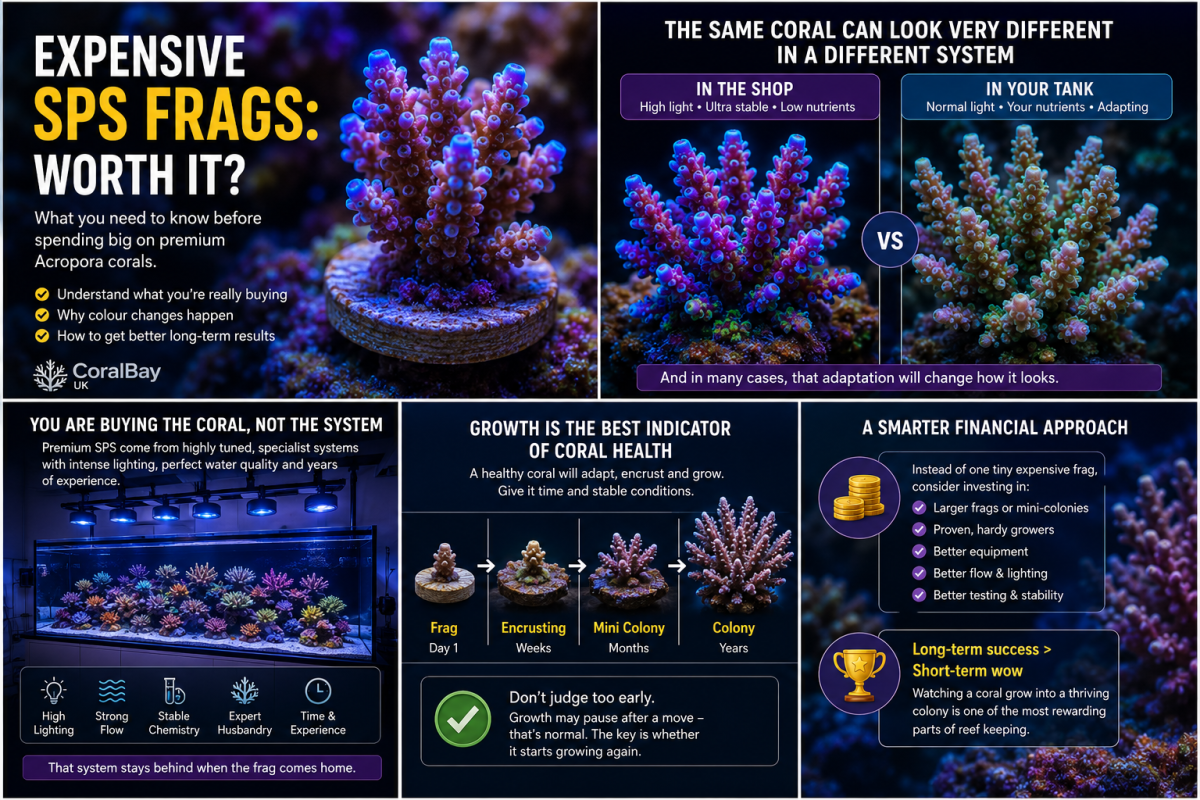
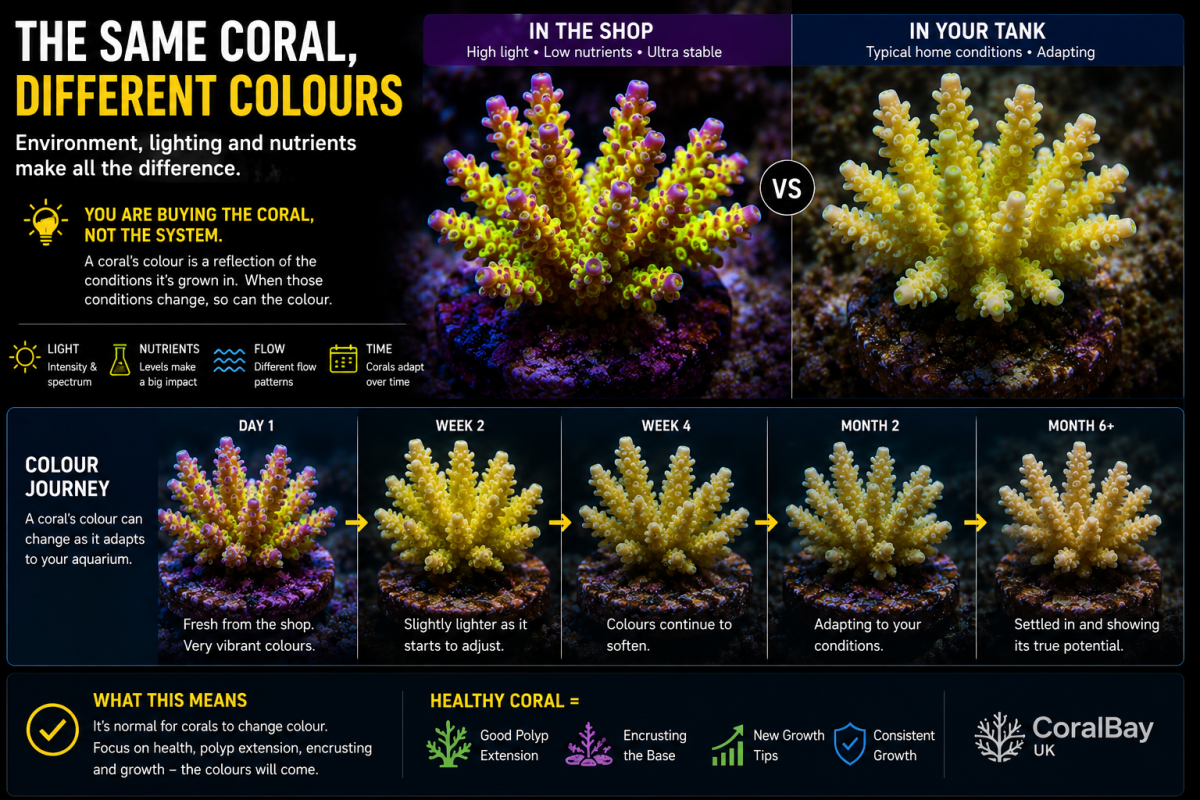
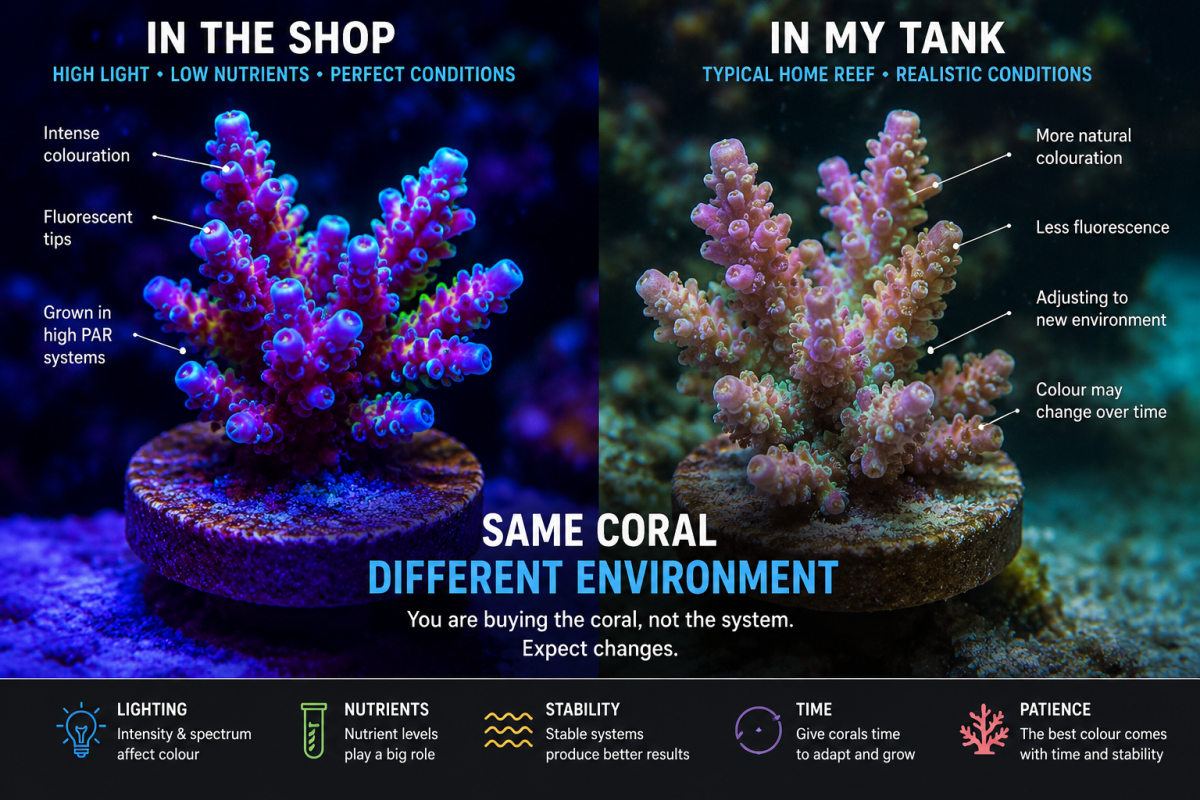
You Are Buying The Coral, Not The System
One of the biggest mistakes new SPS keepers make is assuming that because a coral looks a certain way in one tank, it will automatically look the same in another.
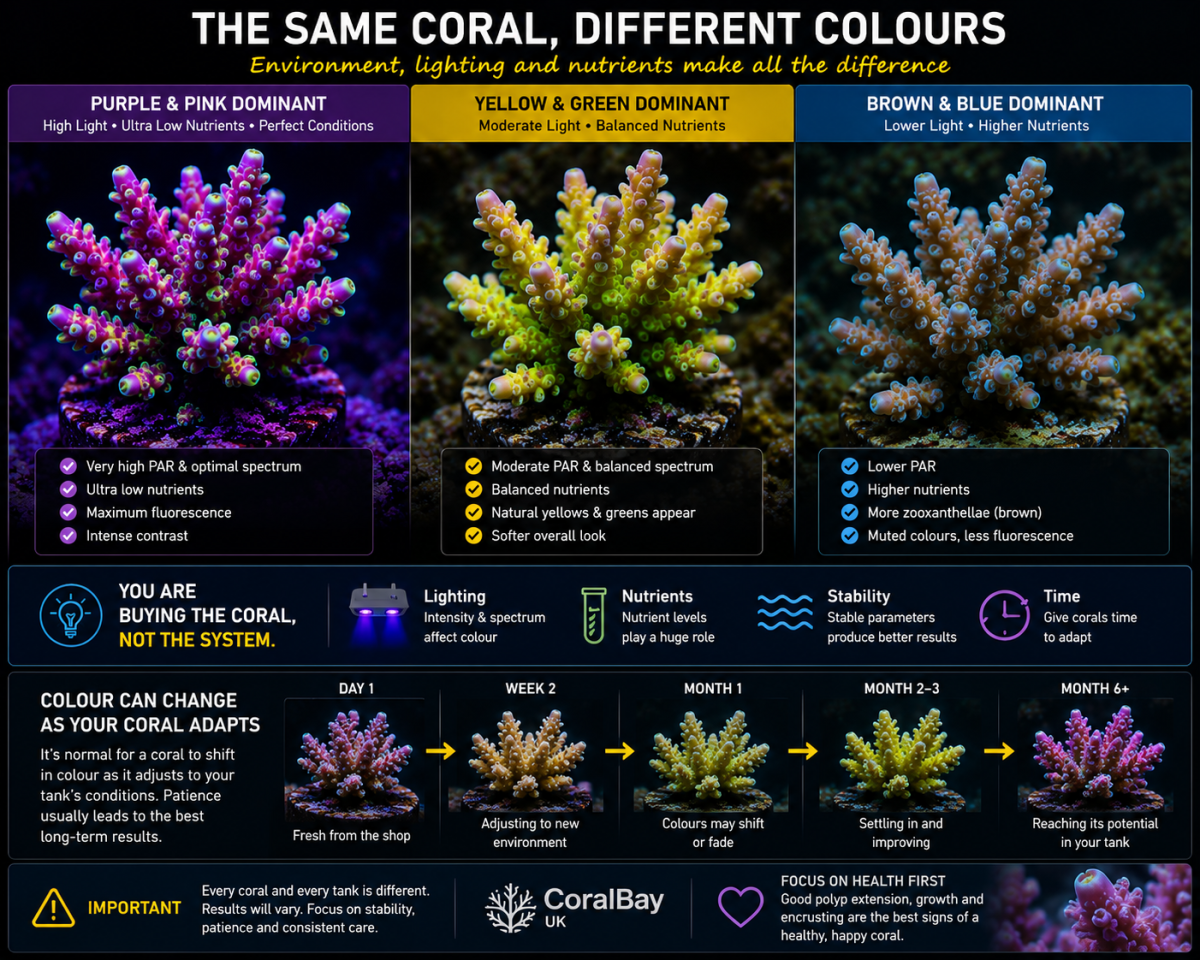
In reality, coral colour is heavily influenced by:
- Light intensity
- Spectrum
- Nutrient levels
- Trace elements
- Water stability
- Flow
- Competition from neighbouring corals
- Feeding
- Overall maturity of the aquarium
What you are really admiring in many premium SPS systems is not only the coral itself.
You are admiring the entire system behind it.
When you buy a frag, the system stays behind.
Tiny Frags Are More Vulnerable Than Many People Realise
Another point worth considering is frag size.
Many highly sought-after SPS corals are sold as very small pieces.
They may be only a few centimetres long.
While these frags often grow rapidly in the system they came from, they can be surprisingly vulnerable when introduced into a different aquarium.
A tiny SPS frag has very little margin for error.
It must adapt to:
- Different lighting
- Different nutrients
- Different bacterial populations
- Different flow patterns
- Different water chemistry
Meanwhile, algae, bacteria and neighbouring corals are all competing for space.
Generally speaking:
Larger pieces tend to be more resilient than tiny frags.
A healthy mini-colony often survives and adapts more easily than a very small high-value frag.
Let’s Talk About Lighting
This is one of the biggest differences between home aquariums and some premium SPS systems.
Many hobbyists run:
- One or two LED fixtures
- Perhaps a hybrid setup
- Moderate PAR levels
There is absolutely nothing wrong with that.
However, some specialist SPS systems are running extraordinary amounts of light.
For example:
- Multiple Radion XR30s
- AI Blades
- T5 supplementation
- Extremely high PAR levels
- Carefully tuned spectrum
Sometimes all of this is concentrated over a relatively small tank.
The result can be spectacular colouration.
The question is:
Are you planning to run your tank in the same way?
For most hobbyists, the answer is no.
And that is perfectly fine.
But it does mean that some corals will inevitably look different once they settle into a more typical home aquarium.
The “Electric Coral” Effect
Many reefers know the famous Miyagi Tort Acropora.
In a typical healthy reef aquarium it is already a beautiful coral.
Yet under certain conditions it can develop extremely intense colouration.
The same coral may then be sold under names such as:
- Electric Miyagi
- Ultra Miyagi
- Rainbow Miyagi
and so on.
There is nothing wrong with that.
But it is worth remembering that much of the colour comes from the conditions in which the coral was grown.
Once moved to a different system, it often settles into a more natural appearance.
Think of it this way.
Some shops are producing SPS “Hulks”.
Once they come home, many of them gradually return to being ordinary humans.
Still attractive.
Still healthy.
Just not quite as exaggerated as before.
Understanding Coral Colour
Much of a coral’s energy comes from microscopic algae called zooxanthellae living inside its tissues.
Zooxanthellae are generally brownish-grey in colour.
The higher the density of zooxanthellae, the more they can mask some of the coral’s fluorescent pigments.
Many intensely coloured SPS corals are maintained in environments where:
- Nutrients are carefully controlled
- Lighting is extremely strong
- Water chemistry is highly stable
- Trace elements are carefully managed
The result can be breathtaking.
However, these conditions often leave less room for error.
A useful analogy might be a fashion model preparing for a major show.
Everything is carefully controlled to achieve a very specific appearance.
Once the show is over, that same person returns to a more normal lifestyle.
Corals often behave in a similar way.
The spectacular colour you see may represent a coral operating at a very specific point on the spectrum rather than its everyday appearance.
What Does Healthy Coral Actually Mean?
Earlier in this article we suggested buying healthy corals and proven growers.
That raises an important question.
What exactly is a healthy Acropora?
Many reefers focus almost entirely on colour.
In reality, one of the strongest indicators of coral health is growth.
A coral that is actively encrusting, extending new branches and laying down skeleton is usually doing something right.
Of course, growth alone does not tell the whole story.
A coral can grow and still be poorly coloured.
Likewise, a coral can be brightly coloured and growing very slowly.
However, given the choice between a coral that is growing well and one that simply photographs well, we would usually favour growth.
One thing to remember is that even the healthiest coral will often pause after being moved.
A coral growing rapidly in a shop system may stop growing for weeks or months after being introduced to a different aquarium.
This is normal.
The coral is adapting.
The real question is not whether growth pauses.
The real question is whether growth eventually resumes.
A coral that settles in, starts encrusting and begins producing new growth tips is usually heading in the right direction.
Where Do Many Premium SPS Frags Actually Come From?
This may surprise some newer hobbyists.
Many of the highly sought-after SPS frags sold in the UK ultimately originate from larger imported colonies.
At the time of writing, many UK reef shops regularly receive Acropora colonies from wholesalers such as TMC, World Fauna and other importers.
Some of these colonies are spectacular.
A colony may arrive looking relatively ordinary, only for certain branches to develop exceptional colouration once placed into a specialist SPS system.
Months later, those branches may be fragged, named and sold individually.
There is absolutely nothing wrong with this.
It is simply part of the modern coral trade.
However, it is worth remembering that some of today’s highly desirable frags may have started life as pieces of colonies that originally cost a fraction of the final retail value.
At the time of writing, an imported Acropora colony might cost anywhere from around £80 to £250 depending on species, size and shop margin
Understanding this helps put pricing into perspective.
You are not necessarily paying for rarity alone.
You are often paying for:
- Time
- Husbandry
- System quality
- Colour development
- Proven survival
- Brand reputation
Whether that premium is worth it is something each reefer must decide for themselves.
There Is Also A Financial Question
Some tiny SPS frags now sell for extraordinary prices.
£100.
£150.
£250.
Sometimes even more.
Will some of these corals become amazing colonies?
Absolutely.
Will some hold their colour?
Possibly.
Will some disappoint their new owners?
Almost certainly.
For many hobbyists, spending the same money on:
- Several larger frags
- A mini-colony
- A selection of proven Acropora
- Better testing equipment
- Better flow
- Better lighting
may produce greater long-term enjoyment.
A Quick Word About Pests
One of the selling points often highlighted by premium SPS vendors is that their corals are pest free.
In our experience, many of these claims are genuine and reflect considerable effort by the seller.
However, reefers should avoid becoming overly fearful of pests.
Yes, it is sensible to inspect new additions.
Yes, dipping corals and following good biosecurity practices is wise.
But the reality is that reef aquariums are living ecosystems.
New organisms can enter a system in many different ways, including:
- Corals
- Live rock
- Sand
- Macroalgae
- Water
- Biological additives
- Equipment transferred from other systems
Every pest in nature has a predator somewhere.
This is not an argument for being careless.
Rather, it is an argument against paranoia.
Do your best to avoid introducing pests.
Buy from reputable sources.
Inspect and quarantine where practical.
But if something unwanted eventually finds its way into your aquarium, don’t assume the hobby is over.
Most experienced reefers eventually encounter a challenge of some sort.
The important thing is learning how to manage it calmly and methodically.
A Different Approach
Instead of chasing every expensive named frag, consider this alternative.
Buy:
- Healthy corals
- Proven growers
- Larger pieces when possible
- Corals you genuinely like
Then focus on:
- Stability
- Growth
- Colour development
- Long-term success
Watching an SPS coral grow from a modest frag into a thriving colony is one of the most rewarding parts of reef keeping.
Many hobbyists eventually discover that growing a coral well is more satisfying than simply buying one that already looks spectacular.
So Should You Stop Buying Premium SPS Corals?
Not at all.
Many premium SPS corals are beautiful.
Some are genuinely rare.
Some are exceptional.
If you enjoy them and understand what you are buying, go for it.
Just keep realistic expectations.
Remember that you are not only buying a coral.
You are buying a coral that has been shaped by a very specific environment.
Once it enters your aquarium, it begins adapting to yours.
And in many cases, that adaptation will change how it looks.
Final Thoughts
Be reasonable.
Be patient.
Don’t assume that the most expensive coral is automatically the best coral.
A healthy, growing SPS colony in your own aquarium is often far more rewarding than a tiny high-end frag that never quite lives up to the photograph.
Some reefers learn this lesson through experience.
Hopefully a few can learn it from this article instead.
This article represents a general discussion about SPS coral keeping and colouration. Results vary between systems and individual corals. No specific shop, seller or coral vendor is being criticised or referred to.