
Live Marine Phytoplankton for Reef Aquariums (UK)
Fresh, UK-grown live phytoplankton cultures for reef tanks, filter feeders, and copepod/rotifer cultures.
Simple, proven species — no marketing “mega-blends”, just what actually works in real reef systems.
Which Phytoplankton Species Actually Matter for Reef Tanks?
show moreshow less
First and foremost, a quick word of honesty.
There are many phytoplankton listings online that rely on long stories, exaggerated claims, or impressive-sounding “multi-blend” formulas.
In practice, for marine reef aquariums there are two main species that are both biologically suitable and realistically available to hobbyists:
Together, these two species deliver most of the achievable biological benefit of phytoplankton supplementation in a reef tank.
What about Isochrysis?
show moreshow less
Typical refrigerated shelf life
- Nannochloropsis: 4–8+ weeks
- Tetraselmis: 3–6 weeks
- Isochrysis: around 7–14 days (often less)
Nannochloropsis (Why it works)
Nannochloropsis is one of the most widely used marine microalgae in aquaculture and reef keeping because
show moreshow less
it offers:
- Very small cell size (around 2–4 µm)
- High EPA (Omega-3 fatty acids)
- Excellent stability and shelf life
- Easy uptake by copepods, rotifers, bivalves, and other filter feeders
- Indirect coral benefits via stronger zooplankton populations
- Minimal risk of fouling when used correctly
Rather than feeding corals directly, Nannochloropsis feeds the reef ecosystem — strengthening the food web corals naturally rely on.
Tetraselmis (Why it works)
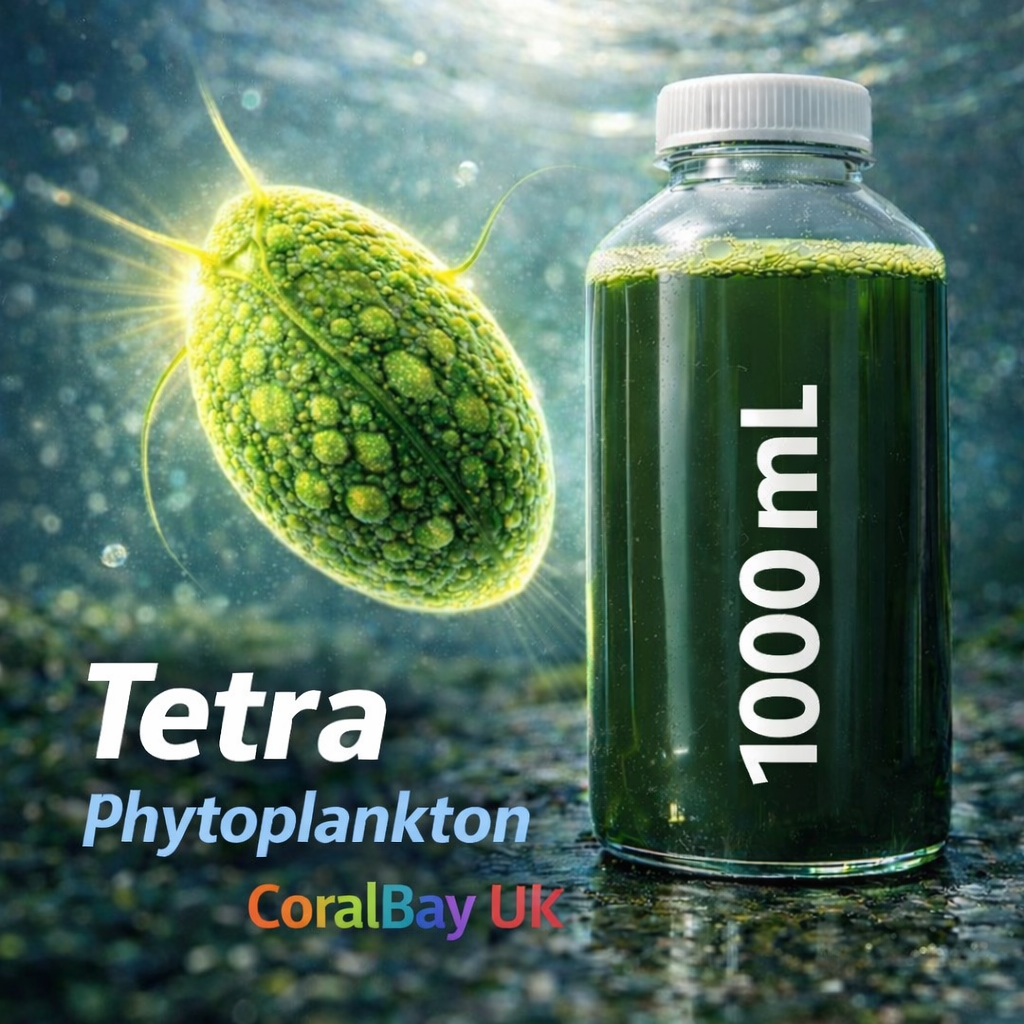
Tetraselmis complements Nannochloropsis with a larger, motile cell (often around 10–14 µm) and a softer, more digestible structure.
Its movement can stimulate feeding responses, and it supports a wider range of filter feeders and zooplankton.
Nanno + Tetra Mix (Why it works)
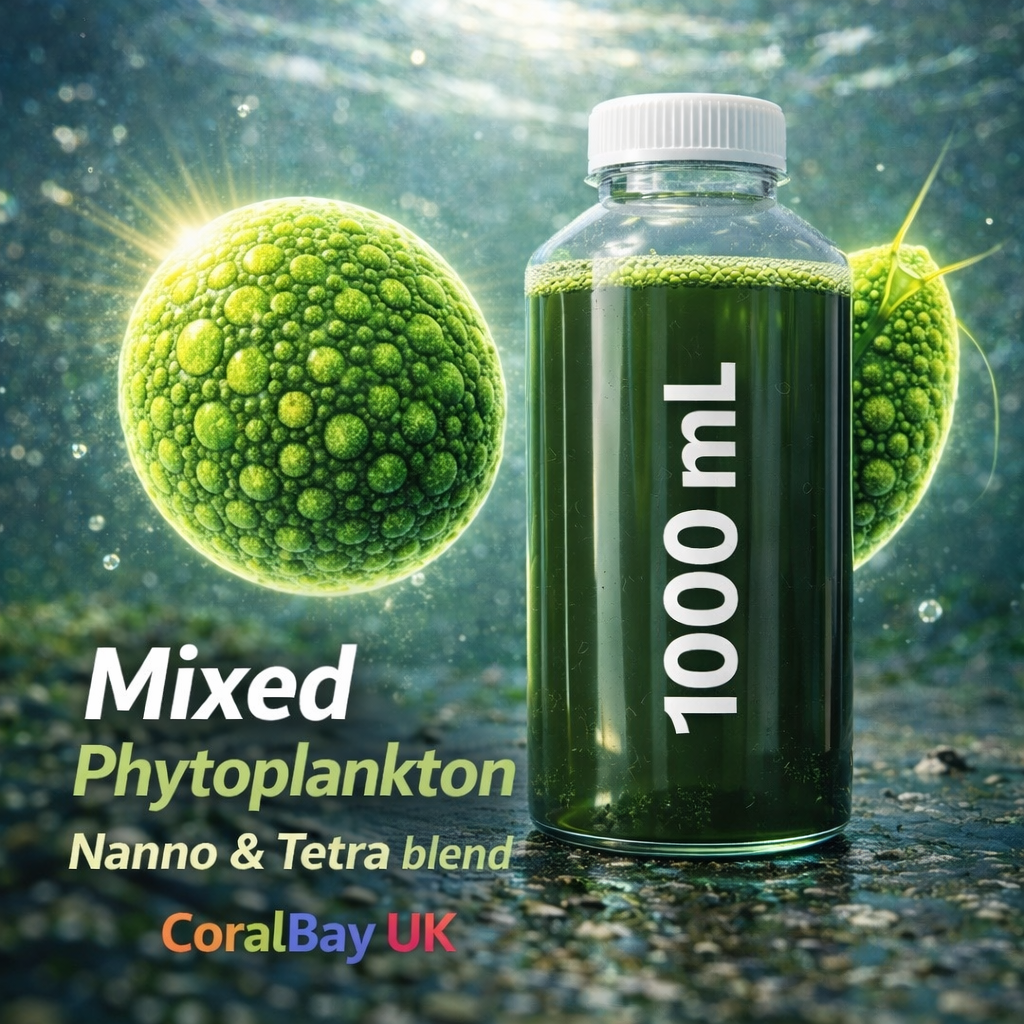
A 50/50 blend combines two complementary cell sizes and nutritional profiles:
Nanno supports consistent pod/zooplankton feeding, while Tetra broadens dietary diversity and feeding response.
Together they provide a balanced, practical “reef food web” phytoplankton profile without relying on fragile species.
Shop Live Phytoplankton
Browse Nannochloropsis, Tetraselmis, or the mixed culture below.
Nanno phytoplankton – live culture
£6.00
In stock
Tetra phytoplankton – live culture
£7.00
In stock
Nanno & Tetra phyto mix – live culture
£7.00
In stock
How to Dose Live Phytoplankton
Live phytoplankton is best used as a gentle, regular supplement rather than a heavy, one-off dose.
Small, consistent additions support copepods, filter feeders, and the wider reef food web without risking water quality.
- Start with a small amount and observe how your system responds
- Most reef keepers dose little and often rather than large single doses
- Dose with pumps running so phytoplankton disperses evenly
- Gently mix the bottle before use to re-suspend cells
Because every reef system is different, ideal dosing depends on tank size, filtration, nutrient levels, and livestock.
If the water clears within a few hours and nutrients remain stable, your dosing level is usually appropriate.
When Not to Dose Phytoplankton
Live phytoplankton is generally gentle, but there are situations where dosing should be reduced or paused:
- If nutrients are already elevated and the system is struggling to export them
- During active bacterial blooms or persistent cloudy water
- If filtration or skimming has been recently changed and the system is unsettled
- When diagnosing unexplained algae or water-quality issues
Phytoplankton works best in stable systems.
If in doubt, pause dosing, allow the tank to settle, and resume gradually once conditions are consistent again.
Phytoplankton FAQs
Which phytoplankton is best for reef tanks?
For most reef aquariums, Nannochloropsis and Tetraselmis are the two most practical and beneficial live phytoplankton species.
Together they support pods, filter feeders, and the wider reef food web.
What is the difference between Nannochloropsis and Tetraselmis?
Nannochloropsis has a very small, stable cell size and is commonly used to feed copepods and micro-zooplankton.
Tetraselmis is larger and motile, making it useful for broader dietary diversity and feeding response.
How long does live phytoplankton last in the fridge?
When stored refrigerated and handled cleanly, Nannochloropsis often lasts around 4–8+ weeks and Tetraselmis around 3–6 weeks.
Always follow storage guidance on the bottle.
How do I dose live phytoplankton?
Start with small, regular doses rather than large one-off additions.
Gently mix the bottle before use, dose with pumps running, and adjust based on how your system responds.
When should I not dose phytoplankton?
Reduce or pause dosing if nutrients are already elevated, the water is persistently cloudy,
you are dealing with a bacterial bloom, or the system is unsettled after major filtration changes.
Resume gradually once conditions stabilise.
Do I need multi-blend phytoplankton for a reef tank?
Not usually. A simple Nannochloropsis + Tetraselmis approach covers the majority of real-world reef needs
without relying on fragile or short-lived species.
How should I store live phytoplankton?
Store live phytoplankton in the fridge, keep containers sealed and clean,
and gently mix before dosing to re-suspend cells evenly.